How do immersive technologies affect human collaboration and task engagement?
Communication and Technology
Collaboration is the basis of our success as a species, so ingrained in us that we engage in collaborative activities regularly and often without even noticing. Technology has always affected how we collaborate with others, and the development of virtual reality and other immersive platforms over the past 10-15 years may be the next big leap in human socialization and collaboration.
“Social virtual reality, in particular, networks multiple users into the same virtual environment, allowing them to interact with their surroundings and one another,” said Media Production, Management, and Technology Assistant Professor Eugy Han.
In a new study, Han joined Portia Wang, a Ph.D. student at Stanford and the study’s lead author, and two other Stanford Ph.D. students, Monique Santoso and Jeremy Bailenson, to examine how collaborative behaviors manifest among teams of people using virtual reality. They also aimed to analyze the roles individual dispositions and contextual differences played in these collaborative activities and how collaborative behaviors related to the perception of group closeness and task outcomes.
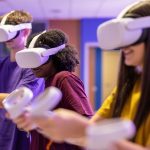
To gather data for their study, Han and her fellow researchers conducted a study during a 2024 university course on virtual reality. Participants went through an onboarding session, where they were given a chance to create their avatars and were taught how to use virtual reality and the devices and software they were going to use. The next week, participants were broken up into groups and tasked with working together to turn an empty space into a replica of a real-world space. They began by creating a list of 3D objects necessary to complete their replica outside the virtual world, then broke up into even smaller groups to start putting their virtual space together using these assets. While using virtual reality to recreate their space, the team of researchers were tracking their movements and discussions to determine their level of engagement with the project and with each other.
After using the tracking and discussion data to quantitatively map each participant’s level of engagement with their task, the team found some notable patterns. Results revealed that participants began the activity in closer bodily alignment, diverging into more independent actions as the session progressed. Collaboration dynamics also emerged in relation to object interactions, with group size negatively predicting individual object creation frequency — consistent with the idea that larger groups redistribute cognitive and spatial resources across more members, leaving fewer opportunities for any individual to contribute new objects.
“We posit that deletion behaviors may reflect a more collaborative mindset, where individuals more regularly revised their work to support task progression, thereby strengthening their perceived connection to the group,” Wang explained.
Going forward, the team hopes that their study inspires further research in this area. Future studies could look at how virtual environments influence the division of labor among groups or how group composition and varying expertise levels among participants affect task engagement.
“These findings highlight the possibilities of leveraging user behaviors in VR to understand the psychological and social processes underlying collaborations and demonstrate how VR can be used to investigate collaborative interactions at scale,” said Wang.
Posted: June 2, 2026
Insights Categories:
Communication and Technology
Tagged as: Eugy Han, Media Production, Management, and Technology, virtual reality