
Join us May 19-21, 2026, for the 2026 Public Interest Communications Summer Institute, which we will hold at the Walter Cronkite School of Journalism and Mass Communication at Arizona State University in Phoenix.
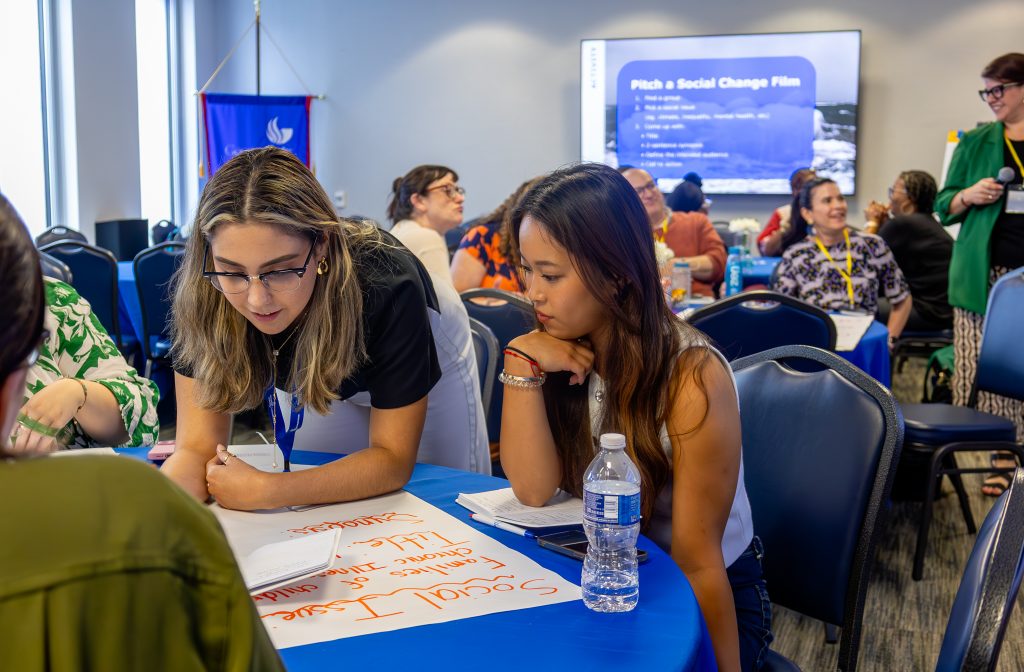
This annual, national interdisciplinary institute brings together educators, researchers, administrators and grad students from communications disciplines—including strategic communications, public relations, journalism and advertising—as well as public health, sustainability, ethnic studies, sociology, behavioral science and related fields. Through hands-on workshops and panels, attendees learn about the emerging academic discipline of public interest communications and innovate ways to introduce it to students. Grad student programming offers low-stakes research brainstorming and presentation practice. This year’s theme relates to belonging, so sessions will explore narrative change around migration, the future of the First Amendment, inclusive journalism, mentorship as a way of belonging and more.
Student registration is pay-what-you-can, $50 suggested for grad students, $15 for undergraduates.
Organizers & Sponsors


Dr. Natalie Tindall
Moody College of Communication
University of Texas at Austin
Sponsor
2026 Theme
In a world shaped by rapid technological change, divisions and shifting social norms, the concept of belonging has emerged as both urgent and multifaceted. Belonging speaks to the human need for connection, recognition and inclusion, yet it is increasingly contested in public discourse and institutional structures. Academic research has long underscored the importance of belonging for individual and collective well-being—Tajfel and Turner’s social identity theory (1979) situates belonging as foundational to group affiliation, while Baumeister and Leary (1995) argue it is a basic psychological need essential to motivation and mental health. In communication studies, belonging is further explored through narratives, language, media representation and organizational rhetoric that shape who is seen, heard and valued.
In the 2026 summer institute, we’ll explore belonging as a communicative practice and a contested space in this moment of division and global uncertainty. How do communication processes foster or constrain belonging? What factors go into deciding who belongs and who does not? Along with these questions, we recognize that fostering belonging and putting it into action often requires courage—to speak across differences, to challenge beliefs and to imagine new forms of connection. Drawing from interdisciplinary research and real-world experiences, we will explore critical, creative and community-engaged perspectives that reimagine belonging and chart a path forward. We ask attendees to consider not only where we belong, how belonging is being redefined across contexts and how those who are told they no longer belong are responding, but what we can do to foster belonging in our classrooms and communities.
Logistics
Hotel: We have secured a room block at the Hampton Inn & Suites Phoenix Downtown, 77 East Polk Street in Phoenix. Use this link to get the discounted room rate of $155 per night.
About the Institute
The Public Interest Communications Summer Institute is an annual gathering that brings together academics, administrators, graduate students and practitioners to learn, share and explore the growing academic discipline of public interest communications. Our aim is to equip a new generation of students with public interest communications and research skills to better position them to address challenging societal problems and adapt to an ever-shifting communications job market.
This year’s summer institute – our fifth! – will be May 19–21, 2026, at the Walter Cronkite School of Journalism and Mass Communication at Arizona State University in Phoenix, Arizona. Learn more about the institute here.
Why attend?
The summer institute is a great place to meet others working in the public interest communications space, make new connections and friends, and gather ideas to take back to your institutions. College and university instructors can learn new teaching techniques and, through our Course Lab, get help with incorporating public interest communications into existing syllabi. College and university administrators can leave with ideas for new course offerings for students. Academic researchers may find potential collaborators, while graduate students have an opportunity to present and get feedback on research and research ideas in a friendly, low-stress environment. Practitioners can hear about the latest academic research pertaining to the field, meet fellow practitioners and learn about opportunities to teach.
Program and Speakers
At the 2026 Public Interest Communications Summer Institute, you’ll get:
- Deep dives into research and practice
- Panel discussions and hands-on workshops
- Programming designed by grad students for grad students to assist with research projects and connect students to expert faculty.
- A half-day Course Lab in which you can work with experts to weave public interest communications into existing courses or create new courses. The goal is for you to leave with tangible skills and concrete ideas that you can take back to your institution and use immediately.
You won’t want to miss our speakers! They include:
- Amanda Mollindo, communications director for ACLU Arizona
- Stephen Menendian, assistant director and director of research at the Othering & Belonging Institute, housed at UC Berkeley
- Joseph Jaafari, founder of LOOKOUT News
- Shondiin Silversmith, an award-winning Indigenous journalist from the Navajo Nation
- Chelsea Reynolds, founding director of the Center for Media & Communities at the ASU California Center
- And many more.
We’ll also be welcomed to ASU by Battinto Batts, dean of ASU’s Walter Cronkite School of Journalism and Mass Communication.
Interactive booth
Responsible Storytelling, Relationship, and Belonging in Indigenous Communications
Stop by and talk to Natasha McKenzie and Jordan Carrier as they explore how responsible storytelling builds belonging through narrative sovereignty, accountability, and place in a way that is both values-based and practical. Drawing on their lived experience as Indigenous women in communications, they bring a unique perspective on belonging, inclusion, and public interest communications that is deeply relational, reflective, and applicable across various sectors. Visitors are invited to engage in conversation, reflection and practical exchange around storytelling challenges from their own work. This conversation is designed to add an important dimension to ongoing discussions about how communication can foster connection without reinforcing division or othering.
Program schedule
TUESDAY, May 19, 2026
6-8:30 p.m. – Welcome reception
Location: Thunderbird Pub, 401 North 1st Street, Phoenix
WEDNESDAY, May 20, 2026
All programming is in the Walter Cronkite School of Journalism and Communication, 555 N. Central Ave., Phoenix.
8 a.m. – Registration opens
Ground floor of the Cronkite building.
8:45-9:30 a.m. – Welcome to Phoenix! Opening Session
Location: First Amendment Forum, Second Floor
Welcome from Dean Battinto Batts. Remarks from Dean Hub Brown. Q&A with Amanda Mollindo, ACLU Arizona communications director.
9:45-11 a.m. – Concurrent Sessions
Public Interest Communications Primer: Frameworks That Foster Belonging for Collectively Addressing Social Problems (Erin Hart and Aaron Zeiler)
Location: Room 252, Second Floor
If you are new to public interest communications or want to dig into its approaches, we are glad you’re at the institute and hope you’ll join us! We’ll walk through the definition for public interest communications (preview: it’s about science, not opinion), and we’ll share frameworks you can put into action. We’ll also consider some examples from the field and hope you’ll bring additional ones to consider together.
Identifying And Changing Narratives Around Migration (Suleiman Amanzad, Álvaro Huerta and Gordon Mayer)
Location: Room 256, Second Floor
Who belongs in the U.S., and who gets to decide? This session invites participants to unpack how migration is framed in the public sphere and to imagine how those frames might be transformed. We will critically examine the stories and narratives that dominate policy debates, media coverage and everyday conversations and how these interact with concepts of citizenship, geography and power. By hearing from community organizers, scholars, and advocates, attendees will explore communications strategies that create alternative narratives, challenge stereotypes and foster dialogue across divides.
11:15 a.m.-12:30 p.m. – Concurrent Sessions
For graduate students: Research presentations and brainstorming
Location: First Amendment Forum, Second Floor
Research brainstorming: A roundtable with a professor at each table will allow students to discuss their research ideas and receive advice on theoretical and methodological approaches. Professors and students will be matched based on their interests. This session is for ideas that are still in development. Professors will offer feedback in a friendly environment, helping students refine their ideas, and students can offer feedback to each other. Tables will be organized by topic.
Research presentations: This session is for projects with complete initial results and findings. As with the brainstorming sessions, professors and students will be matched by issue. It is suitable for students who would like to send their manuscripts to faculty ahead of the institute (optional but not required – you can always bring your results to the institute to discuss them).
Throughline: Lessons from History and Efforts to Bridge Divides in a Polarized America (Gina Baleria and Edith Asibey)
Location: Room 314, Third Floor
This year – 2026 – marks the 250th anniversary of the Declaration of Independence. As the country marks this milestone, many are asking whether the nation is living up to its democratic ideals, particularly given that political polarization erodes democracies. This session examines polarization throughout the country’s history, offering a throughline and vital context as well as hope. Surveys show Americans across the political spectrum long to decrease division and increase communication, connection and belonging. We’ll hear about the promising initiatives that are bringing people together today to promote dialogue, build trust, and strengthen democratic participation through communication. Speakers will share insights and practical takeaways for those seeking to invite people in rather than push them away.
Who Decides Who Belongs? Indigenous Sovereignty, Storytelling, and the Politics of Memory (Natasha McKenzie and Jordan Carrier)
Location: Room 252, Second Floor
Before borders, before institutions, before the language of inclusion and exclusion, there was already belonging. And yet, in the present moment, Indigenous peoples are asked, once again, to justify their place: in the nation, in the media, even in conversations about their own lands. This session moves through that contradiction. Bringing together voices from across Turtle Island, we reflect on belonging not as a status granted, but as a relationship lived, one that is often denied through the stories institutions choose to tell. In journalism, in climate spaces, in public discourse, Indigenous presence is too often visible yet unheard, present yet displaced. What is at stake is not only representation, but memory. If belonging can be rewritten, it can also be erased. Through documentary practice, journalism, and Indigenous storytelling, we ask
- What stories have made Indigenous peoples appear as outsiders in their own territories
- What happens when those stories are interrupted?
- And what becomes possible when Indigenous voices speak not as subjects, but as authors of the world they inhabit?
This is not a conversation about inclusion. It is a return to something more fundamental: the recognition that belonging was never lost, only denied.
12:45-1:45 p.m. – Q&A with the Deans and Lunch
Location: First Amendment Forum, Second Floor
We’ll serve lunch while having a conversation with Battinto Batts, dean of ASU’s Walter Cronkite School of Journalism and Communication, and Hub Brown, dean of the University of Florida’s College of Journalism and Communications. The conversation will be led by Natalie Tindall, director of the Communication and Leadership degree program at The University of Texas at Austin.
2-3:15 p.m. – Concurrent Sessions
Rebuilding Trust and Legitimacy in Higher Education through Public Interest Communication (Nader Dagher, Ehsan Zaffar, Amanda Kehrberg and Lauri Hennessey)
Location: Room 252, Second Floor
Public trust in higher education has declined sharply, raising urgent questions about the legitimacy of universities and their role in democratic life. This legitimacy crisis is not simply a reputational issue; it is an ethical and civic one. Higher education institutions play a foundational role in fostering democratic values and civic engagement. Yet, their ability to do so is increasingly constrained. Public interest communication provides a unique framework for addressing this challenge. This panel will explore the intersection of communication, power, and legitimacy as well as how public interest communications can be leveraged to rebuild trust and legitimacy in higher education through participatory storytelling, transparency campaigns, student–community collaboration and more.
More than Mentorship (Chris Omni, Jovan Osborne, Ashley Powell)
Location: Room 314, Third Floor
Mentorship is not simply about guidance—it’s about connection, advocacy, and belonging. This session nurtures a vision of mentorship as a shared journey of becoming, where each participant serves as both teacher and student, mentor and mentee. Rooted in the principles of public interest communications, this workshop explores mentorship as a relational practice that builds bridges across generations, disciplines, and identities. Through storytelling, reflective dialogue, and collaborative exercises, participants will discover how to create networks that not only support professional growth but also sustain emotional well-being and community resilience. By the end, attendees will leave with new language, deeper self-awareness, and tangible skills for building relationships that matter—relationships that heal, uplift, and help us all move forward together.
Developing an Inclusive Journalism Curriculum (Joseph Jafaari and Chelsea Reynolds)
Location: Room 256, Second Floor
Traditional journalism has left many communities feeling unheard. How might we invite students to practice journalism in a way that fosters belonging? In this workshop, Joseph Jaafari, founder and executive editor of LOOKOUT Publications, and Chelsea Reynolds, founding director of the Center for Media & Communities at the ASU California Center, explore how journalism can engage and empower communities. They’ll also offer ways for faculty to introduce the practice of inclusive journalism to students.
3:30-4:45 p.m. – Concurrent Sessions
Recognizing disinformation and building counternarratives (Joshua Garland and Peggy-Jean Allin)
Location: Room 252, Second Floor
How do stories and messages shape our beliefs and actions? What happens when the stories are part of a disinformation campaign, and how can we recognize and counter them? In this workshop, the director of ASU’s Center on Information and Narrative Complexity and other experts will highlight the latest research into disinformation then lead participants in a hands-on activity in which they craft – and interact with – both information and disinformation. The activity will reveal how narrative, framing, and cognitive bias interact—and how to respond thoughtfully within today’s complex information environment.
Belonging in Action Begins With Connection in Quietude (Chris Omni and Piper Hendricks)
Location: Room 314, Third Floor
Whether you are an educator, nonprofit communicator, student, or someone working to make sense of an ever‑shifting world, you likely face unique pressures—from absorbing a constant stream of challenging news to navigating polarization, social conflict, and global uncertainty. This reflective and practical session recognizes that those of us in public interest communications need space for belonging, too. We need connection—within ourselves, with our peers, and with the world we are trying to understand and make more hospitable to all. This interactive workshop is designed to help you ground yourself—literally. Weather permitting, we’ll step outside to create space for you to prioritize your own wellbeing. Together, we’ll explore how wellness can be sustained amid the stress and anxiety fueled by ongoing events and the complexity of today’s public conversations. We’ll consider how modeling this balance can benefit our students, colleagues, and communities, and how small, intentional practices can create lasting real‑world impact. Through conversation, mindfulness strategies, and peer exchange, you’ll leave with ideas to adapt your own routines to reinforce that resilience and care are not luxuries, but necessities.
The Power of Bridging (Stephen Menendian)
Location: Room 256, Second Floor
Bridging is a powerful intentional practice where members of different social groups not only meet, but make connections through learning about each other and hearing others’ stories. It is not mean to identify areas of agreement, but to enable people to understand how others see themselves and the world. In this workshop, Stephen Menendian, assistant director of the Othering & Belonging Institute at the University of California Berkeley, will engage participants in a bridging activity and provide them with the tools they need to integrate bridging into their own lives.
THURSDAY, May 21, 2026
All programming is in the Walter Cronkite School of Journalism and Communication, 555 N. Central Ave., Phoenix.
8:30 a.m. – Registration opens
Locaton: First Amendment Forum, Second Floor
9-10:15 a.m. – Concurrent Sessions
Charting the Future of the First Amendment: Recent Shifts and Implications for Educators, Journalists, and Public Interest Communicators (Gregg Leslie, Gina Baleria, Ruth DeFoster)
Location: Room 252, Second Floor
Our collective dialogue about free expression is at a critical inflection point. Recent court decisions and sweeping legislative proposals are reshaping the scaffolding of the First Amendment. In this session, leading scholars, practitioners and policy analysts will unpack the shifts, analyzing how these legal currents are rippling through classrooms, newsrooms and advocacy organizations and examining what the future may hold. Participants will leave with a clear sense of what emerging norms might look like for educators, journalists and public interest communicators as well as practical tools for navigating uncertainty while safeguarding the principles that underpin an open society.
The Power of Perception and Persuasion: Tools for the Classroom and Beyond (Harry Singh and Dean Batson)
Location: Room 256, Second Floor
We are more connected than ever, yet feel increasingly divided. In this moment, persuasion has not disappeared but has changed. This workshop invites educators and practitioners to examine how perception shapes meaning long before a message is delivered. Through creative icebreakers and unexpected visual examples, participants experience how quickly assumptions form and how those assumptions influence trust, openness, and a sense of belonging. Grounded in Social Penetration Theory, the session: 1) shows how connection develops or breaks down based on what people believe they see and understand about one another; 2) explores how these mental shortcuts operate differently in today’s attention-saturated learning environments, where students are multitasking, navigating algorithmic feeds; and 3) provide participants practical, classroom-ready concepts and activities they can immediately apply in their courses, organizations, or communities. These strategies help learners communicate across differences, recognize bias, and use persuasion in ways that strengthen connection, promote belonging, and support meaningful engagement in a divided world.
10:30-11:45 a.m. – Concurrent Sessions
Collaborating With Communities, For Communities – Engaging Publics in Participatory Decision Making on Science and Technology Issues (Jennifer Richter, Nicholas Weller and colleagues)
Location: Room 252, Second Floor
Learn how a team of academics – including experts from the Consortium for Science, Policy and Outcomes at Arizona State University – is working with the federal government to ensure that everyone in Arizona has a voice in nuclear waste management decisions that will affect their community. The team has developed a participatory engagement process designed to empower and encourage those who are not already at the table to share their values and opinions. This session also will offer reflections about convening deliberative conversations with the public on complex topics.
Getting published: from idea to publication (Spiro Kiousis, Benjamin Johnson and colleagues)
Location: Room 314, Third Floor
So you have an idea. How do you develop it into a publishable journal article? In this workshop, emerging scholars will get tips from editors of communication journals about how to develop an idea into a piece that will be accepted.
12-12:45 p.m. – Closing Session
Reflections on belonging (Stephen Menendian, Fariba Pajooh, Kevin Hardges and Natasha McKenzie)
Location: First Amendment Forum, Second Floor
Throughout the institute, we will invite attendees to answer questions about belonging, both in writing and by visiting a storytelling booth. In this closing session, we’ll curate the answers, reflect on them and invite attendees to share their thoughts.
End of formal programming
2-5 p.m. – Course Lab: Weaving public interest concepts into your courses in challenging times
Location: First Amendment Forum, Second Floor
Do you want to weave public interest communications into your courses, but need some help?Are you wondering how best to discuss politically charged issues if you’re in a state where language is legislated and ideas are policed?
In this session, we’ll show you how to integrate public interest communications concepts and frameworks into your courses or create new courses.We’ll also share our collective knowledge and experiences to highlight how to help your students think critically about the world, even when you have to choose your words carefully. This workshop is designed for instructors from all fields, ranging from public health, sustainability, and journalism to political science, corporate social advocacy, and more. This session is free but please let us know you are coming, especially if you have a specific course you would like to workshop.