
Templates, guides, resources and more can be found in the UF Brand Center https://brandcenter.ufl.edu/
Our brand is what potential and current students, faculty, alumni, and industry professionals all think, feel and respond to when they hear the University of Florida College of Journalism and Communications mentioned. These assets are provided to support faculty, staff and students in the telling of our College’s brand story and identity.
Request support or new creative
Faculty and staff can request assistance from the CJC Communications and Events Teams by using the CJC Marketing and Communications Services Request Form
We provide creative services and communication expertise to support CJC faculty, staff and student employees in the telling of our College’s brand story and identity. We use this form to start creating intentional and strategic campaigns, research promotion, designs, multimedia, etc., to better connect your audience with your department, program, event, service, or opportunity. This form is a jumping-off point for our conversation.
Please allow at least 2 business days for a team member to respond to your request. Please submit projects as early as possible, aiming for a minimum of 2 weeks in advance for most projects and 3 weeks for print projects.
Logos and Templates
Logos
Please use the official UF College of Journalism and Communications logo unless you have an approved secondary logo for your department, division, center, or unit. Do not alter this logo in any way, such as distorting the dimensions, cropping, or adding/deleting text. When creating assets for your department, division, center or unit for audiences outside of UF, please ensure that you primarily use the university and college logos as outlined in the UF Brand Center.

Email Signatures
Information about the UF Signatures and how to generate yours can be found here: https://brandcenter.ufl.edu/email-signature-generator/
Powerpoint and Research Poster Templates
There are two styles of PowerPoint templates to choose from. Each style has an orange and a blue version. If you need a fast and easy template, choose the “minimalistic” template. If you want a bit more “wow” in your presentation, choose the “CJC” template. This template includes more options for text and photo layouts. Both presentation templates come with a graph/chart section to input data, too.

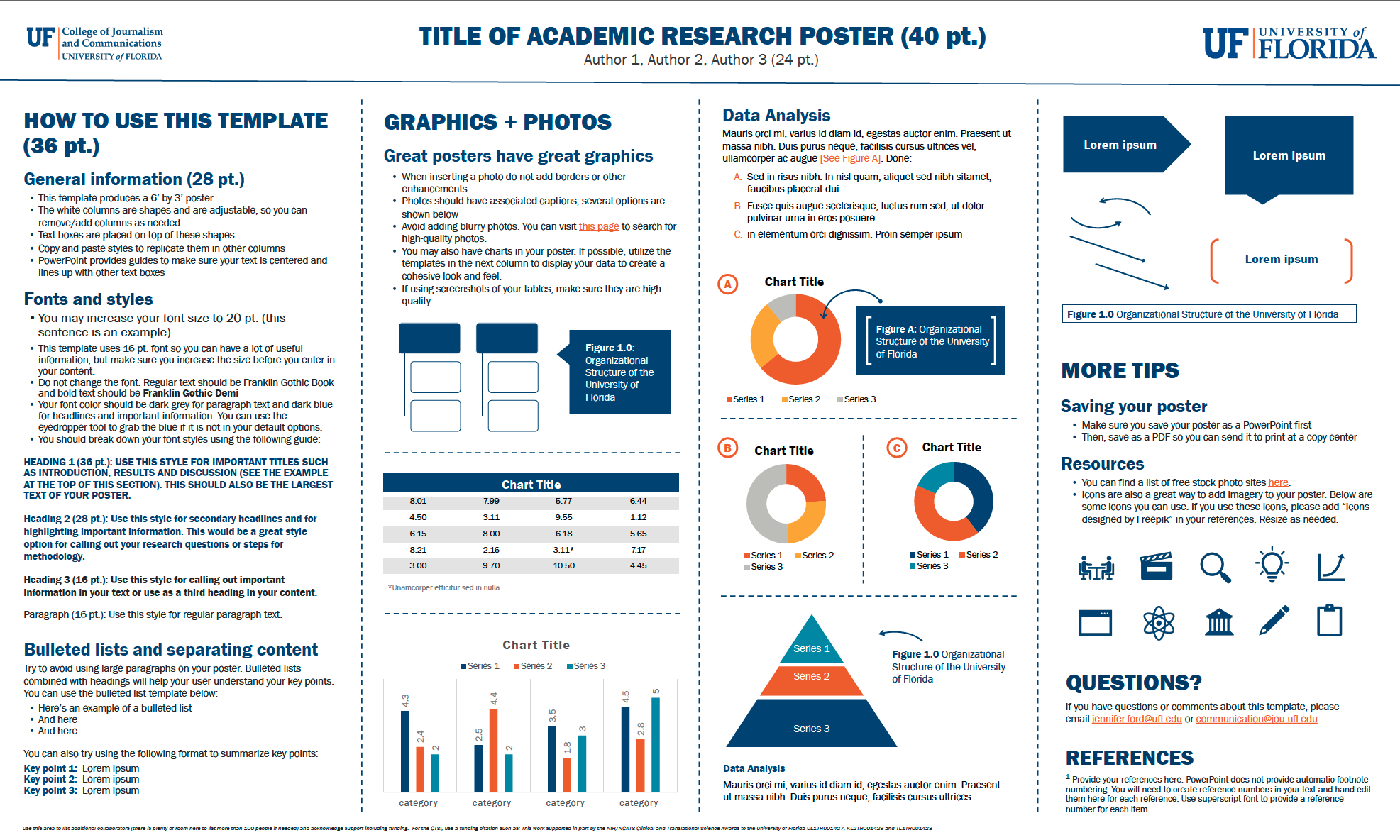
Download CJC Research Poster Templates
Social Media
Follow the College’s primary social media accounts @ufjschool.





All UF social media accounts must follow the UF Social Media Policy.
https://policy.ufl.edu/policy/brand-social-media-management/
Social media accounts require planning, resources, and collaboration, as well as knowledge of accessibility requirements and UF rules and regulations. All official CJC social media accounts require approval from the CJC Communications Department and the Dean. Then it must also be approved by the University. Please fill out this form or contact Jen Ford at jennifer.ford@ufl.edu to register any new or existing social media accounts.
All accounts must follow the UF Social Media Guidelines.
Accessibility and Social Media
All social media must meet accessibility guidelines provided by UF and Title II guidelines.
Social media is an important tool for sharing information. When social media is used by the College’s students, employees and/or public to carry out or participate in its core educational and administrative activities, all available accessibility-supported features of the platform should be used whenever possible.
Add meaningful alt text to images, graphics and GIFs — describe the information a user needs to understand the post.
Caption every video — edit auto-generated captions for accuracy, including names, acronyms and technical terms.
Use CamelCase hashtags — e.g., #GoGators instead of #gogators so screen readers can distinguish individual words.
Check color contrast — don’t rely on color alone to communicate information; make text easy to read.
Keep graphics simple — limit text, avoid clutter and use legible typefaces.
Don’t put essential information only in an image — repeat important details in the post copy or alt text.
Use emojis sparingly — never use emojis as a substitute for words or important information.
Write descriptive links — use meaningful link text instead of “click here.”
Think about audio, too — make sure important information conveyed visually or audibly is available in another format.
Build accessibility in from the start — don’t treat it as something to fix after the post is designed.
Ask yourself: If someone can’t see the image, hear the video or distinguish the text, can they still get the same information?
Some additional accessibility resources:
- UF Accessibility
- UF Social Media Guides and Trainings
- https://www.afb.org/consulting/afb-accessibility-resources/afbs-social-media-accessibility-standards
- Guidelines for Digital Image Descriptions
- Understanding Accessibility on Social Media
- Color Contrast Checker
Questions?
Please email communication@jou.ufl.edu.