
Bumps in the Road (and Online Conversation): Zandvoort 2026 Insights
by Adela Wiercioch and Ellie Gómez Tovar
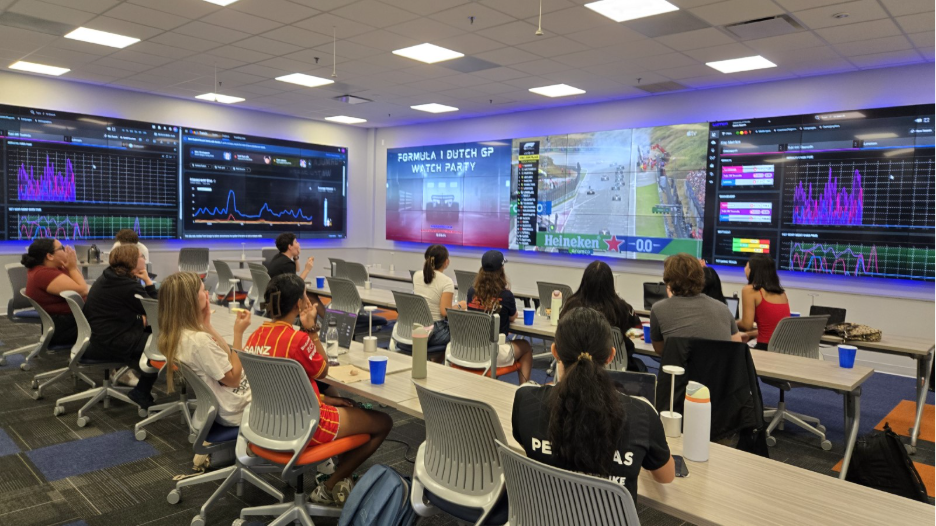
On Aug. 23, the Atlas Lab hosted UF’s Motor Bella club to watch the F1 Zandvoort Grand Prix to monitor the twists and turns of the race and the real-time social media buzz. Six minutes into the start of the race, Red Bull’s Max Verstappen would send his car into a wall and effectively reset the race, along with everyone’s expectations.
In the 24 hours before the race, long-time fan-favorite Max Verstappen was mentioned online between 9,000 and 21,000 times per hour. During that time, Lando Norris, the McLaren driver who secured the pole position, was only mentioned between 1,000 and 16,000 times per hour. Verstappen, 28, was celebrating his last hometown race before Zandvoort leaves the race calendar in 2027.
All eyes were on the leading Red Bull driver, who is known for his prowess in rainy conditions and has never finished off the podium in this race since 2021.
Track conditions for the race were tenuous, with the rain having stopped just minutes before the cars got onto the track. Fans and drivers alike were concerned about how the weather would affect drivers’ performance, with online comments speculating what could happen and what tires drivers would be starting the race with.
However, as the cars turned into the second lap of the race, Verstappen’s dip onto a wet part of the track sent him spinning into the wall, bringing his race to an abrupt, unexpected finish.
At the time of the crash, 3:06 PM CEST (9:06 AM EST), there were around 13,300 online results generated by fans mentioning Verstappen. Comparatively, the hashtag “#DutchGP” was only mentioned in around 3,800 posts during that time.
In the event of a red flag event such as this, the drivers wait for the track to clear, and teams regroup to discuss strategy. Results online varied from criticizing track conditions to general shock.

Aside from Verstappen, other drivers were discussed as their performance during the race was evaluated. Audi’s Nico Hulkenberg and Gabriel Bortoleto were especially discussed, with fans reacting to their impressive recovery skills in the wake of Verstappen’s crash, as were Ferrari’s Charles Leclerc and Lewis Hamilton, whose radio comments and controversial team strategy left fans divided.
The data on global engagement shows that unforeseen situations drive more conversation online than anticipated outcomes; the race was always going to have a winner, but crashes are often far more unpredictable and spur more online commentary.
Although many F1 fans online criticized Verstappen’s miscalculation and subsequent crash, Lumen by Talkwalker sentiment analysis characterizes 25.4% of conversation about “Max” and 20.8% of conversation about “Verstappen” as positive, compared to the 15.4% and 14.4% of conversation for the same keywords that was classified as negative.
Despite Red Bull Racing and Verstappen’s initial strategizing, all it took was a slight miscalculation on a wet area of the track to derail the entire grid. Afterwards, Verstappen took to social media to express his regrets over how his time in the race ended and was met with overwhelming support. As of Sept. 14, his post has earned 466,000 likes and 2,900 comments.
In F1, as in business, it is critical to foster positive relationships with fans, consumers, and sponsors. Verstappen’s aggressive driving and complicated history in the early days of his racing career could have easily made him even more polarizing in the F1 community, but one look at his social media reveals a genuinely supportive fanbase that was happy to see a beloved driver walk away from an accident relatively unscathed.
Verstappen dominated social media conversation from midnight on Aug. 23 to 11:59 on Aug. 24, with Lando Norris, the winner of both the race and the Driver of the Day audience vote, only becoming the primary focus in the minutes immediately after his victory.

Interestingly, data show that Verstappen fuels dialogue even when he doesn’t have any accidents on the track. In the two races since Zandvoort, Verstappen came in third place in Monza, Italy, and second place in Madrid, Spain, but results for his name across social media regularly eclipse those for his competitors on any given race weekend.
In fact, Mercedes driver Andrea “Kimi” Antonelli, who took first place in both races, only outpaced Verstappen’s online mentions immediately after his win in Monza. Similarly, Verstappen was discussed far more than the other drivers who placed during these two races, Mercedes’ George Russell (second place, Monza) and McLaren’s Lando Norris (third place, MADRING).

Though all four men are in good standing in the race for the championship, Verstappen has been active for the longest time, having debuted in 2015; Norris and Russell debuted in F1 in 2019, with Antonelli coming onto the scene in 2025. Could this contribute to Verstappen’s overwhelming domination of online mentions?
While many of the F1-related conversations on social media are certainly driven by the individual drivers’ talent and their performance in any given race, it is also possible that their reputations affect their online relevance. If that is the case, what happens when F1’s biggest names inevitably retire?
It will be interesting to continue following the sport in this age of social media as drivers come and go, and as newer drivers become more established names in the industry, bringing together their own fanbases through a combination of their on-track skills and off-track personalities. Perhaps all that is needed to reach Verstappen’s level of online fame is time.
For more Zandvoort Grand Prix social media insights, please check out the Atlas Lab’s companion Instagram post
Category: Atlas Lab Insights
Tagged: Atlas Lab F1 Grand Prix Social Media
Subscribe to our News Digest